
Filler Board
Falcon Link TR supplies filler board from Sharjah, UAE, used to fill and isolate expansion and movement joints in concrete. Learn the types, the thicknesses (12, 20, 25 mm and others) and how to choose, then request a quote.
Key Features
Applications
Product Range
Filler board is a compressible board that fills a movement or expansion joint in concrete so that slabs and walls can move without cracking. It is usually bitumen-impregnated fibreboard, foam or cork, in common thicknesses such as 12, 20 and 25 mm. Falcon Link TR supplies filler board from Sharjah for contractors and consultants.
What is filler board used for?
Concrete expands in the heat and shrinks as it cures. If slabs, walls and columns are cast tight against each other, they crack. A filler board placed in the joint gives the concrete room to move, keeps the two pieces separate and forms a clean joint line. A sealant on top finishes the surface.
Types of filler board
| Type | What it is | Typical use |
|---|---|---|
| Bitumen fibreboard | Fibreboard impregnated with bitumen | Expansion joints in slabs, pavements and walls |
| Polyethylene foam board | Closed-cell foam sheet | Light movement joints, behind sealant |
| Cork filler board | Natural cork composition | Joints needing recovery and a natural material |
| Polystyrene filler | Expanded polystyrene board | Temporary or low load joints |
| PP hollow board | Rigid plastic board | Formwork stops and protection, see PP hollow sheet |
How thick should the filler board be?
| Joint width | Typical filler thickness | Notes |
|---|---|---|
| 10 to 15 mm | 12 mm board | Common for small slab joints |
| 20 mm | 20 mm board | Common for slabs and floors |
| 25 mm | 25 mm board | Wider joints and heavier movement |
Thickness is chosen to match the joint width on the drawing. Confirm the joint width and the specification with the consultant before ordering.
Filler board standards: what do specifications ask for?
Specifications often name ASTM D1751 for bitumen fibre expansion joint filler, and other standards such as ASTM D1752 for cork or BS 6093 for joint design. Ask your consultant which standard the project requires, and ask us for the supplier datasheet. We do not state that a board meets a standard unless the supplier documents it.
How to install filler board
- Clean the joint face and the slab edge.
- Cut the board to the joint depth, leaving room for the sealant on top.
- Fix the board to the first pour with adhesive or nails so it does not move.
- Pour the second slab against the board.
- Cut back the top and apply backer rod and sealant to finish.
Common mistakes
- Using the wrong thickness for the joint width.
- Letting the board get soaked before the pour.
- Leaving gaps between boards so concrete leaks through.
- Filling the whole depth with board and leaving no space for sealant.
- Choosing board without checking the specification.
Filler board and related materials
Joint work often also needs sealant and backer rod. See our tools and adhesives range, and the floor protection sheets to cover finished slabs while other trades work. Browse the full product catalogue.
Where joints are needed
| Location | Why a joint is needed | Filler board role |
|---|---|---|
| Between slab and wall | The slab and wall move at different rates | Isolates the two so the wall is not pushed |
| Around columns | Columns settle and expand independently | Prevents cracks radiating from the column |
| Long slabs and pavements | Heat expansion over long runs | Gives room to expand at set intervals |
| Between old and new concrete | New concrete shrinks as it cures | Separates the two pours cleanly |
| Near water-retaining walls | Movement and watertightness both matter | Works with a water stopper and sealant |
Filler board compared with other joint materials
| Material | Role | Notes |
|---|---|---|
| Filler board | Fills the full joint depth | Compressible, cut to joint thickness |
| Backer rod | Supports sealant at the top of the joint | Used with filler board or on its own |
| Sealant | Weatherproofs the finished joint surface | Applied over backer rod |
| Water stopper | Blocks water through the joint | Separate product, see formwork accessories |
Handling and storage in UAE heat
- Store boards flat, under cover and off wet ground.
- Keep bitumen board out of direct sun so it does not soften or warp.
- Cut boards on site to the exact depth just before fixing.
- Check for damp or damaged edges before using a board.
Planning quantities
Measure the length of every joint and the depth you need, then convert to boards or rolls using the board size. Add a margin for cutting waste, usually a small percentage. Count each joint separately, because joint depths on slabs, walls and columns often differ.
Joint details to confirm with the consultant
- Joint width and spacing on the drawing.
- The filler material and standard in the specification.
- Whether a water stopper or dowel bars also cross the joint.
- The sealant type and the depth left for it.
Choosing filler board by project type
| Project | What to look for |
|---|---|
| Villas and houses | Standard thickness for slab-to-wall joints, easy to cut and fix |
| Warehouses and industrial floors | Board that holds its shape under heavy wheel loads at the joint edge |
| Podium and basement slabs | Moisture-resistant board and attention to the waterproofing detail |
| Roads, pavements and external paving | Wider joints and board that copes with large temperature swings |
| Swimming pools and water tanks | Joint materials that suit continuous water contact, confirmed with the consultant |
What to include in a filler board enquiry
- The filler type you need, or the specification clause.
- The joint width and depth from the drawing.
- The total length of joint, or the number of boards or rolls.
- Whether you need the board cut to size.
- The delivery area and when you need it.
Quality checks when the board arrives
- Check the thickness with a gauge or ruler against your order.
- Check the board is dry, flat and free from crumbling edges.
- Check the label or datasheet matches the type you ordered.
- Store it flat and keep it under cover until it is fixed in the joint.
If you are not sure which type your specification means, send us the clause or a photo of the existing joint and we will help you match it before you place an order.
How to order
Send the board type, thickness, sheet size or roll size, quantity and delivery area through our contact page. If you have a specification clause, include it so our team can check what we can supply.
Frequently Asked Questions
What is filler board used for?
It fills a gap between concrete elements so they can expand and contract without cracking, and it forms a clean joint line for sealant. It is widely used between slabs, walls and columns.
What thickness of filler board do I need?
It should match the joint width on the drawing. 12, 20 and 25 mm are common. Check the specification with your consultant and send us the width you need.
What is bitumen fibre filler board?
It is a fibreboard impregnated with bitumen, which makes it water-resistant and compressible. It is widely used for expansion joints in slabs and walls, and is often named in specifications.
Is filler board the same as backer rod?
No. Filler board fills the full joint depth between two slabs. Backer rod is a round foam cord pushed into the top of the joint to support sealant. Many joints use both.
Which standard applies to filler board?
Specifications often cite ASTM D1751 for bitumen fibre joint filler. The project consultant decides which standard applies, so check the specification and ask for the datasheet.
Can filler board be used in wet areas?
Bitumen-impregnated board resists moisture better than plain fibreboard. Foam types do not absorb water. Tell us the location and we will help you choose a suitable type.
How many sheets of filler board do I need for a joint?
Multiply the joint length by the joint depth for the area, then divide by the sheet area. A 1200 x 2400 mm sheet is 2.88 square metres. Add extra for cutting. Send us the joint length, depth and thickness and we can check the quantity with you.
Can filler board be cut to a strip width?
Yes. Board can be cut to the width and depth of the joint on site, and cut-to-size strips can be requested. Give us the strip width, depth, thickness and length so we can confirm what is available before you order.
What is the difference between filler board and polystyrene joint filler?
Bitumen fibreboard is water-resistant and compressible and is common in slab and pavement joints. Polystyrene is rigid foam used mainly for isolation. Always check compressibility and the named standard in the specification before substituting either.
How should filler board be stored on site?
Keep sheets flat, dry, off the ground and under cover. Avoid direct sun and hot closed vehicles in summer, because bitumen softens in heat. Wet or swollen board should not be installed in a joint.
Do all slab joints need filler board?
No. Which joints need filler board, and what type, is set by the structural drawings and the consultant. Expansion and isolation joints usually do. Check the joint schedule and send us the thickness and quantity you need.
You May Also Need
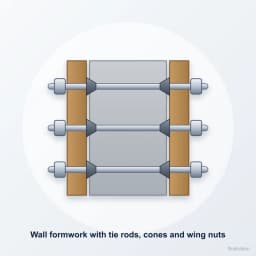
Formwork & Shuttering Accessories
Formwork and shuttering accessories for walls, columns and slabs: tie rods, wing nuts, cones, water stoppers, clamps, spacers and rebar caps.

Fasteners, Anchors & Fixings
Fasteners, anchors and fixings for concrete, block, steel and plasterboard: drive pins, nails, wall plugs, through bolts, bolts and nuts, and GI wire.

Lighting Solutions
LED lighting solutions for UAE construction, industrial, and commercial projects. High-bay LED fittings for warehouses (100W–200W), IP65 batten lights, LED panel lights, emergency luminaires with 3-hour backup, and site work lights. Sourced for UAE climate. CE/RoHS certified.
Ready to Order? Get a Free Quote Today
Contact our team for competitive pricing, custom orders, and fast UAE-wide delivery.