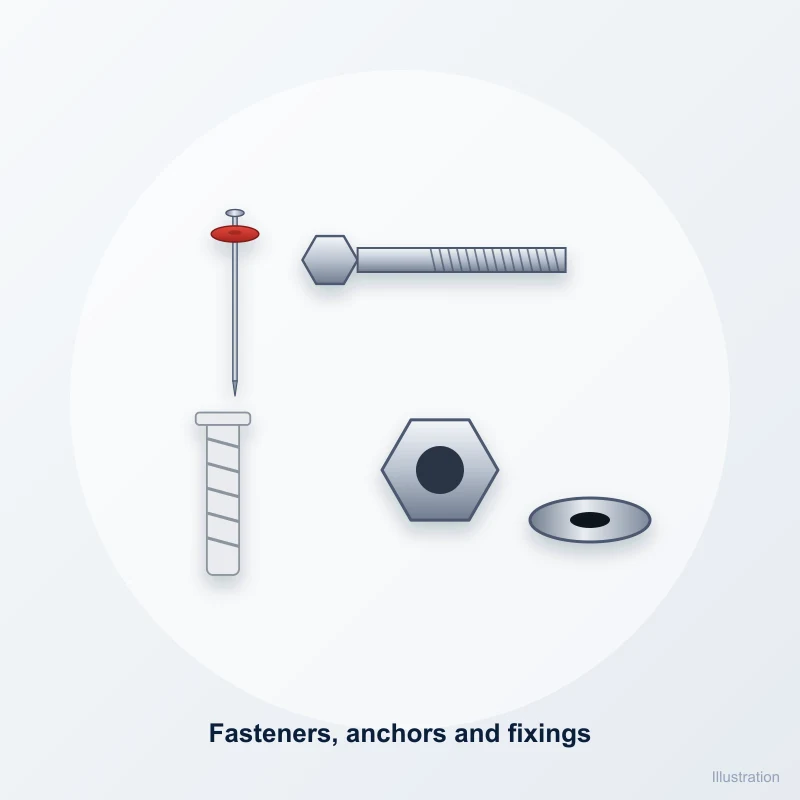
Fasteners, Anchors & Fixings
Falcon Link TR supplies fasteners, anchors and fixings from Sharjah, UAE. Find drive pins, gun nails, steel nails, wall plugs, through bolts, bolts, nuts, washers and GI wire, with a guide on which fixing suits which wall.
Key Features
Applications
Product Range
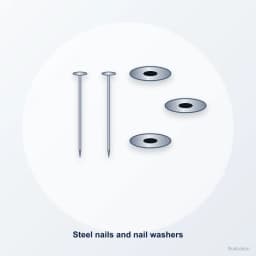
Black Steel Nails & Nail Washers
Type: black steel wire nail, flat head | Length: about 1 to 6 inch (25 to 150 mm) | Finish: black, bright or galvanised (to confirm) | Also: nail washers | Supply: by kg or carton (to confirm)
Black steel wire nails and nail washers for timber, plywood and shuttering work. Sold by length and weight, with sizes and finishes confirmed at quote stage.
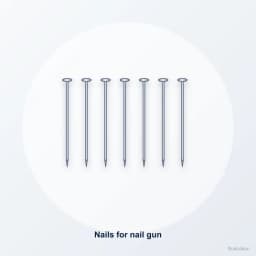
Gun Nails (DN27)
Code: DN27 (meaning to be confirmed) | Likely length: about 27 mm (to confirm) | Form: loose or collated strip (to confirm) | Used with: nail gun | Supply: boxed, quantity to confirm
Nails for gun, listed as DN27, are made to be fired from a nail gun for fast repeat fixing. The code has not been matched to a datasheet yet, so confirm length and gun fit with our team.
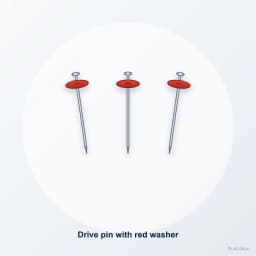
Drive Pin with Red Washer (PDW27 / PDW32)
Codes: PDW27, PDW32 | Likely length: about 27 mm and 32 mm (to confirm) | Washer: red | Driven by: powder-actuated tool | Base: concrete, steel | Supply: boxed, quantity to confirm
Drive pins with red washer, coded PDW27 and PDW32, are fired into concrete or steel with a powder-actuated tool to hold track, channel and batten. Confirm exact length and tool match with our team.
Fasteners are the parts that hold materials together, and the right choice depends on what you are fixing into. Falcon Link TR supplies fasteners, anchors and fixings from Sharjah for contractors, fit-out teams and workshops across the UAE.
What are fasteners, anchors and fixings?
A fastener joins two parts. An anchor grips a base material such as concrete or block so that something can be fixed to it. A fixing is the whole assembly, for example a plug and screw, or a drive pin and washer. The wrong fixing in the wrong base material either fails or damages it.
Which fixing for which base material?
| Base material | Suitable fixings | Page |
|---|---|---|
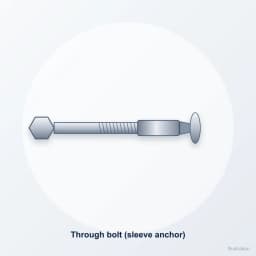
| Solid concrete | Through bolts, drive pins, plugs and screws | Through bolt |
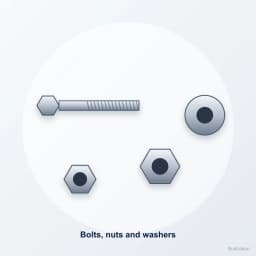
| Steel | Drive pins, bolts, nuts and washers | Bolts, nuts and washers |
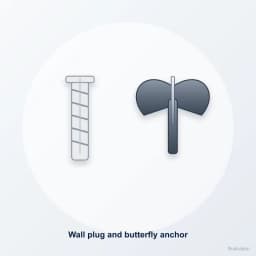
| Block and brick | Wall plugs, sleeve anchors | Wall plugs |
| Plasterboard | Butterfly plugs and cavity anchors | Butterfly plugs |
| Timber | Steel nails and screws | Steel nails |
Drive pins, gun nails and wire nails: what is the difference?
| Item | Fired or hammered | Typical use |
|---|---|---|
| Drive pin with washer | Fired with a tool | Fixing channels, track and fittings to concrete or steel, see drive pins |
| Gun nail | Fired from a nail gun | Fixing into concrete and masonry, see gun nails |
| Steel nail | Hammered by hand | Timber and soft materials |
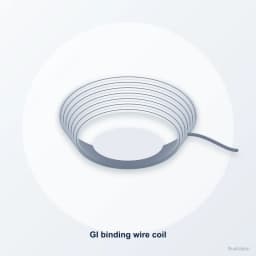
| GI wire | Tied by hand | Rebar tying and binding, see GI wire |
How to choose a fastener
- Identify the base material and how thick it is.
- Estimate the load: light, medium or heavy.
- Choose the type: plug, anchor, nail or bolt.
- Choose the finish: zinc for dry indoor, galvanised outdoor, stainless coastal.
- Add washers, nuts and spare quantities.
Which finish suits UAE conditions?
| Location | Suggested finish |
|---|---|
| Dry indoor | Zinc plated |
| Outdoor inland | Hot-dip galvanised |
| Seafront and wet areas | Stainless steel |
Common mistakes with fixings
- Using a plain plug in hollow block.
- Mixing metric and inch sizes.
- Using a light plug for a heavy load.
- Drilling the wrong diameter.
- Skipping washers on soft or thin material.
How to read fastener sizes
| Size | What it means |
|---|---|
| M10 x 100 | Metric bolt, 10 mm thread, 100 mm long |
| S8 | Wall plug for an 8 mm drilled hole |
| SWG 18 | Wire gauge, about 1.2 mm thick |
| 4.6 or 8.8 | Bolt strength class |
Common jobs and the parts they need
| Job | Parts |
|---|---|
| Fixing a handrail to a slab | Through bolts, washers, nuts |
| Hanging a shelf on a block wall | Wall plugs and screws |
| Fixing track to concrete | Drive pins with washers |
| Securing a plasterboard fitting | Butterfly plugs |
| Tying reinforcement | GI wire, spacers, rebar caps |
Installation basics
- Check behind the wall for cables and pipes.
- Drill to the size and depth the fixing needs.
- Clean the hole of dust.
- Fit the fixing and tighten to the specified torque.
- Test by hand before loading.
When to ask an engineer
For overhead, structural or safety-critical fixings, the engineer should specify the fixing type, size, depth and spacing. We supply what they specify.
Planning quantities
Count the fixing positions on the drawing, multiply by the number of fixings per position, and add an allowance for loss and damaged parts. Fixings are small, cheap compared with delays, and are easy to run short of mid-job.
Understanding load types
Fixings face different forces. A pull-out load tries to draw the fixing from the wall, a shear load pushes across it, and a combined load does both. A shelf bracket puts shear and pull-out on its plugs, and a hanging rod puts pure pull-out on its anchor. The fixing must be chosen for the worst load it will see.
Choosing between plug, anchor and chemical fixing
| Fixing | Strength | Typical use |
|---|---|---|
| Plastic plug and screw | Light to medium | Shelves, frames, small fittings |
| Sleeve or wedge anchor | Medium to heavy | Rails, racks, brackets |
| Chemical anchor | Heavy | Edges, cracked concrete, critical loads |
| Drive pin | Light to medium | Track and channel into concrete or steel |
Corrosion and finishes
Galvanised and zinc coatings protect steel by sacrificing themselves, so they wear away over time, faster in salt air and standing water. Stainless steel resists corrosion much longer but costs more. Match the finish to where the fixing lives and how long it must last.
Storing fasteners
- Keep boxes dry and off the floor.
- Label sizes clearly.
- Do not mix grades in one bin.
- Return unused parts to their original boxes.
Which fixing for which UAE job?
| Job | Typical environment | Finish to ask for |
|---|---|---|
| Interior fit-out shelves and fittings | Dry, air-conditioned | Zinc plated |
| Outdoor handrails and signs | Sun, dust, occasional rain | Hot-dip galvanised |
| Seafront balconies and marine work | Salt air and humidity | Stainless steel |
| Ductwork and MEP supports | Mostly dry, inside the building | Zinc plated or galvanised |
| Temporary works and formwork | Short term, rough use | Plain or galvanised |
What we need to quote you
- The item, size and length.
- The base material you are fixing into.
- The finish and strength grade.
- The quantity and delivery area.
- A photo or sample if you are matching an existing part.
Related guides
See how to choose between a through bolt and a wall plug, and how to read the sizes on bolts, nuts and washers. For concrete work, see the formwork accessories.
Mixing metric and inch sizes
Some tools, fittings and imported equipment use inch threads, while most building fixings use metric. Sizes such as 3/8 inch and M10 look alike but do not interchange, and forcing the wrong nut onto a bolt damages both. Check the thread on the existing part before ordering, and send us a sample or a clear photo if you are not sure.
Spares and returns
Order a small margin of each fixing, because parts get dropped, damaged or lost. Keep unused fixings in their boxes with the size label so that they can be used on the next job without sorting.
If you are not sure which fixing suits your job, describe the wall or base material, what you are fixing and roughly how heavy it is, and our team will point you to the right page and size.
How to order
Send the item, size, length, finish, quantity and delivery area through our contact page. See also formwork accessories and the product catalogue A to Z.
Frequently Asked Questions
What is the difference between a fastener and an anchor?
A fastener joins parts together. An anchor grips a base material such as concrete or block so that something can be fixed to it. Many fixings use both.
Which anchor suits concrete?
It depends on the load. Light loads can use plugs and screws, while heavy loads use through bolts. Always check the engineer's detail for structural fixings.
What is a drive pin with a red washer?
It is a hardened pin with a washer that is fired into concrete or steel with a tool to hold light fixings such as track and channel. Our drive pin page explains the sizes.
What fixing do I use for plasterboard?
Use a butterfly plug or cavity anchor, which opens behind the board and spreads the load across the back. Plain solid-wall plugs can pull out of plasterboard, so check the weight of what you are hanging first.
Are galvanised fasteners fine outdoors in the UAE?
They suit most outdoor inland locations and general site work. For seafront and very humid sites, stainless steel lasts longer because salt air attacks zinc coatings, so ask us about stainless options for those jobs.
Can I order mixed fixings in one quote?
Yes. Send us the list of items, sizes, finishes and quantities, plus your delivery area, and we will confirm what we can supply together and what needs to be ordered for you.
You May Also Need
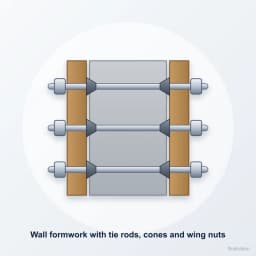
Formwork & Shuttering Accessories
Formwork and shuttering accessories for walls, columns and slabs: tie rods, wing nuts, cones, water stoppers, clamps, spacers and rebar caps.

Lighting Solutions
LED lighting solutions for UAE construction, industrial, and commercial projects. High-bay LED fittings for warehouses (100W–200W), IP65 batten lights, LED panel lights, emergency luminaires with 3-hour backup, and site work lights. Sourced for UAE climate. CE/RoHS certified.

Stationery Products
Wholesale stationery and office supplies stocked in Sharjah: A4 copy paper (80gsm), writing instruments, ring binders, filing supplies, cable and pipe markers, site diaries, and printer consumables. Bulk pricing for corporate offices, government entities, and construction site offices.
Ready to Order? Get a Free Quote Today
Contact our team for competitive pricing, custom orders, and fast UAE-wide delivery.