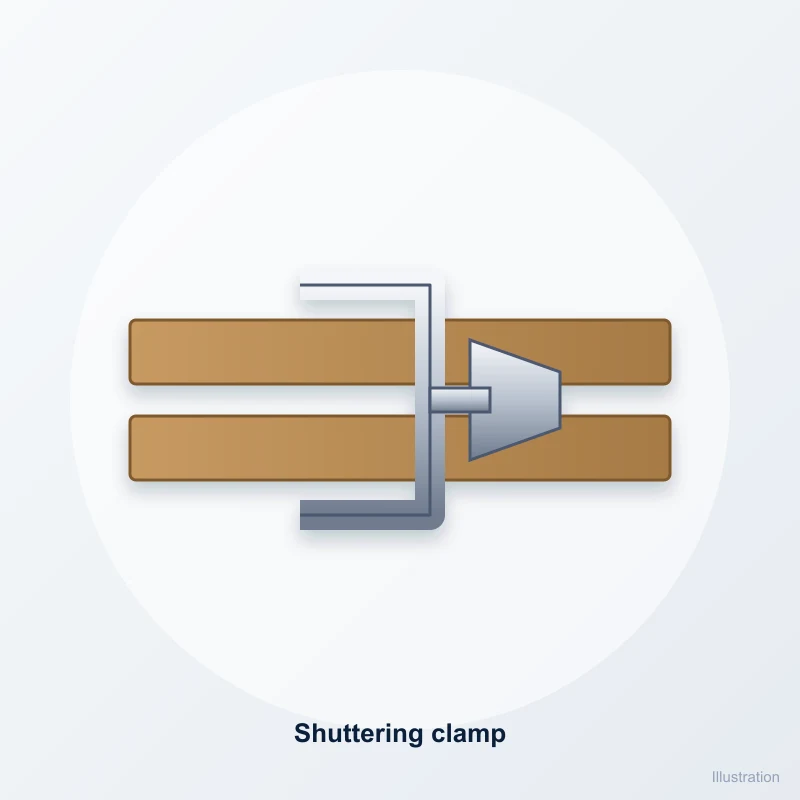
Shuttering Clamp
Material: steel | Type: formwork clamp for plywood and timber | Used on: slab edges, beam sides, columns | Supply: per piece or carton
Shuttering clamps hold plywood and timber formwork together at slab edges, beam sides and columns. Supplied from Sharjah, with a guide to choosing between clamps and tie rods.
Key Features
Applications

A shuttering clamp is a steel clamp that holds plywood or timber formwork panels tight against each other and against the concrete edge. It is used where a tie rod cannot pass through, such as slab edges, beam sides and small column forms. Falcon Link TR supplies shuttering clamps from Sharjah.
What is a shuttering clamp used for?
On a slab edge or a beam side there is no second form face for a rod to pass through. A clamp grips the form from the outside and resists the pressure of the wet concrete. On small columns, clamps run around the outside of the form and are tightened with a wedge or bolt.
Which clamp for which element?
| Element | How the clamp is used | Points to check |
|---|---|---|
| Slab edge | Clamps hold the edge board to the deck formwork | Board thickness and clamp opening |
| Beam side | Clamps hold the side form against the soffit | Beam depth and spacing |
| Small column | Clamps wrap around the form and are tightened | Column size and form thickness |
| Straight wall stop-end | Clamps hold the stop-end board in place | Whether a tie rod would be a safer choice |
Clamps differ in opening size, strap length and tightening method. Give your form thickness and the element so our team can match the right one.
Shuttering clamp or tie rod?
| Choose | When |
|---|---|
| Shuttering clamp | Edges, beam sides, small columns, where nothing can pass through the form |
| Formwork tie rod | Walls and larger columns with two accessible faces, see formwork tie rod |
| Both together | Tall or heavy forms where the designer asks for rods plus perimeter clamps |
A clamp is not a substitute for a rod on a tall wall. Follow the formwork drawing and the designer.
How to choose a shuttering clamp
- Note the thickness of the plywood or timber you are clamping.
- Decide which element you are forming: edge, beam side or column.
- Check the pour height and speed with your designer.
- Pick the clamp type and size, then add a small allowance for loss and damage.
Tips for UAE sites
- Heat softens timber glue faster, so inspect clamped forms again before the pour.
- Clean concrete off the clamp after striking, or the screw thread will seize.
- Store clamps dry and oiled, especially near the coast.
Common mistakes with shuttering clamps
- Using a clamp with the wrong opening, so it slips under pressure.
- Spacing clamps too far apart on a deep edge.
- Leaving concrete on the screw, which then seizes.
- Clamping a damaged or swollen board that will bow.
- Relying on clamps where the drawing calls for tie rods.
Inspection before the pour
- Check every clamp is tight and square to the form.
- Check the board has no splits and sits flat on the deck.
- Look for bent clamp arms or stripped screws and swap them out.
- Check the form line against the drawing before concrete arrives.
Problems and fixes
| Problem | Likely cause | Fix |
|---|---|---|
| Clamp slips | Opening too large for the board | Use a smaller clamp or pack the gap |
| Board bows between clamps | Spacing too wide | Add clamps or a back-up timber |
| Screw will not turn | Concrete on the thread | Clean and oil after every use |
Storing and reusing clamps
Strip clamps as soon as the concrete allows, knock off any concrete, oil the screw and stack them dry. A little care means the same clamps serve many pours.
Planning quantities
Measure the total length of edge or the number of beams and columns, apply the spacing your designer gives, and count the clamps. Keep some spare clamps on site, because they are the first things lost during striking and moving forms.
What to send us for a quote
- The thickness of the plywood or timber being clamped.
- The element: slab edge, beam side or column.
- The quantity and delivery area.
- A photo of the clamp you use now, if you have one.
What to buy with shuttering clamps
Most customers also need tie rods, wing nuts and wing plates and concrete spacers. See the complete formwork and shuttering accessories range.
Request a quote
Send the form thickness, element type, quantity and delivery area through our contact page.
Use Cases
Slab edge boards
Clamps hold the edge board in line and resist the push of the wet slab.
Beam side forms
Clamps keep the side form tight against the soffit during the pour.
Column forms
Clamps around the outside of a small column form stop the panels opening.
Frequently Asked Questions
What is a shuttering clamp?
It is a steel clamp that holds plywood or timber formwork panels tight at slab edges, beam sides and small columns, where a tie rod cannot pass through the form.
What is the difference between a shuttering clamp and a tie rod?
A clamp grips from outside and is used where there is only one accessible form face. A tie rod passes through two faces of a wall or column and holds them together. Many jobs use both.
How do I choose the size of a shuttering clamp?
Match the clamp opening to your plywood or timber thickness and the element being formed. Give us the form thickness and element type, and we will suggest a suitable clamp.
How many clamps do I need per metre of edge?
Spacing depends on slab thickness, pour speed and the clamp type, so there is no single figure. Ask your formwork designer, then count positions along the edge on the drawing.
Can shuttering clamps replace tie rods?
No. On tall walls the tie rods carry the load across the wall. Clamps help at edges and sides but should not replace the rods that the formwork drawing calls for.
How do I look after shuttering clamps?
Remove concrete as soon as the form is struck, oil the screw or wedge, and store the clamps dry. A cleaned and oiled clamp lasts through many more pours.
More from Formwork & Shuttering Accessories
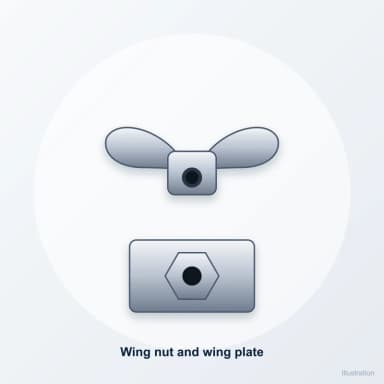
Wing Nut & Wing Plate
Parts: wing nut and wing plate (waller plate) | Fits: formwork tie rod, typical 15 or 17 mm | Material: steel or cast iron | Finish: black or galvanised (confirm) | Supply: loose, sold per piece or carton

Rebar Cap (Safety Cap)
Material: plastic (PVC or similar) | Types: round, mushroom, square-top | Fits: common rebar diameters (about 8 to 32 mm) | Colour: often orange or red | Supply: per piece or bag

PVC Water Stopper (Waterstop)
Material: flexible PVC | Profiles: ribbed flat, centre bulb | Typical widths: 150, 200, 230, 250 mm | Typical roll length: 10 to 25 m | Use: concrete construction and movement joints | Supply: by roll or by metre
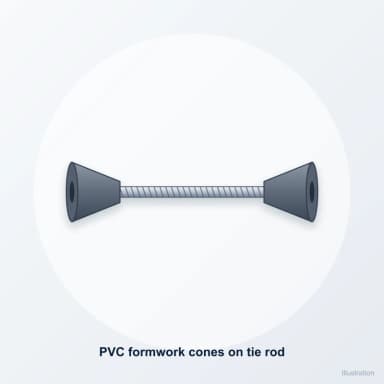
PVC Cone (Formwork Cone)
Material: PVC | Fits: formwork tie rod and spacer tube | Common tie rod sizes: 12 mm, 15 mm, 17 mm | Colour: grey or black (varies by lot) | Supply: loose, sold per piece or carton
Ready to Order? Get a Free Quote Today
Contact our team for competitive pricing, custom orders, and fast UAE-wide delivery.